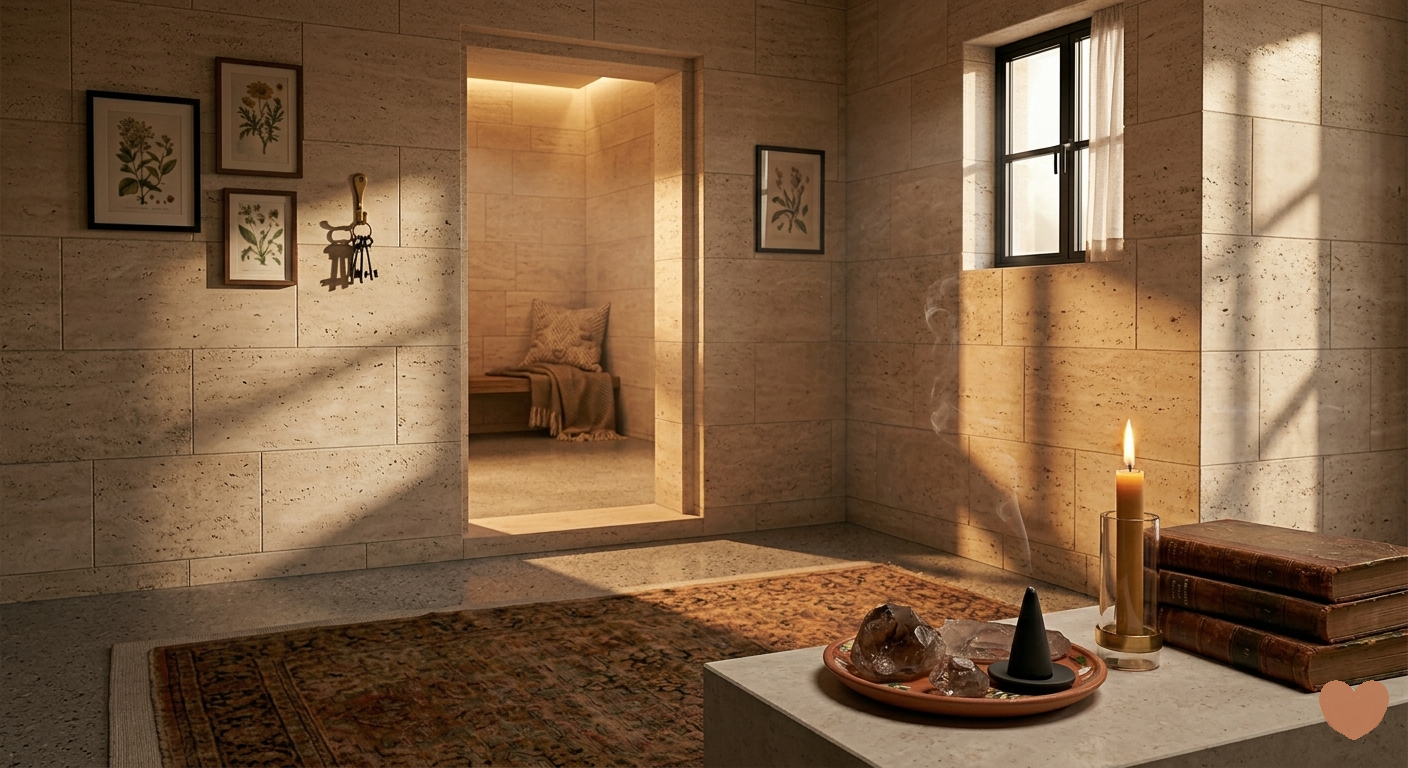
Most people have felt it without being able to name it. A room that immediately quiets something in the nervous system. A threshold crossed that marks a shift in internal state. A home that somehow produces the person who lives inside it — rather than merely housing them. This is not atmosphere. It is not aesthetic. It is nervous system regulation through spatial design, and it is as old as every ancestral spiritual tradition that ever specified how sacred space should be built.
Domestic metaphysics — the study of the home as a living biological and metaphysical system — is not a new discipline. It is the recovery of one. Every tradition that left us a built environment left us a set of principles about how that environment should function, what its thresholds should signal, how its materials and proportions and atmospheric conditions should interact with the body and the spirit of the person inside. Spatial intentionality is the common thread: the home is not background, it is instrument. And like any instrument, it functions at the level of its design. Chronobiological alignment — the home’s responsiveness to the daily, lunar, and seasonal rhythms of the body it contains — is one dimension of that design. This site documents all seven.
The Metaphysics of Space
The home operates as a nervous system map. Every threshold, proportion, and material carries functional energetic logic rooted in ancestral sacred memory — the Law of Correspondence, the principle that the outer domestic environment is a direct mirror and driver of the inner state, is not philosophical: it demands specific physical implementation. Chi, prana, and mana are not competing explanations — they are three traditions independently mapping the same spatial mechanism. The practitioner who has felt that some homes immediately settle the body while others agitate it without any obvious cause is already inside this argument.
→ The Foundational Framework#the-metaphysics-of-space#
Sacred Environmental Engineering
Spiritual design is not aesthetic — it is the deliberate architectural alignment of focal points, acoustic fields, and olfactory triggers to produce specific neurological states. The altar is a cognitive priming system before it is a devotional object. The terpene-limbic pathway — the direct neural route through which specific resins access the amygdala before conscious processing engages — is why incense has appeared in ritual contexts across every major tradition without exception. If the spatial intentionality that Pillar 1 establishes as the foundational principle demands anything, it demands the environmental engineering documented here: the home built to produce the states it intends to produce.
→ The Implementation System#sacred-environmental-engineering#
The Home as a Living Organism
Each room functions as a distinct biological node. The bedroom is hypnagogic architecture — the deliberate engineering of the alpha-theta transition through which the sleeping practitioner enters the threshold state that spiritual traditions have always recognized as the site of significant inner work. The kitchen is a somatic regulation practice, not a nourishment metaphor. The living room is a collective coherence field — what it produces in a household’s shared nervous system is either designed or accidental, but it is not neutral. For the home organism to function at this level, it must breathe with chronobiological alignment — the room-by-room zoning is only as reliable as the circadian and lunar rhythms it is synchronized with.
→ The Room-by-Room System#the-home-as-living-organism#
Chronobiological and Cyclical Living
The home must breathe with biological time — responding to circadian light cycles, lunar sleep architecture, and seasonal circannual entrainment as functional design requirements, not lifestyle preferences. Full moon phases reduce NREM deep sleep in documented ways. The winter solstice is a circannual reset point where spectral light deficit, metabolic stillness, and ancestral hearth logic converge at a single biological event. The practitioner whose practice holds through spring and erodes by January without understanding why will find the structural cause here — in the home’s failure to recalibrate with the biology its inhabitants are living inside.
→ The Time Dimension#chronobiological-cyclical-living#
The Home as Protective Envelope
For the vulnerable nervous system — in grief, trauma, illness, or early development — the domestic environment is not comfort. It is clinical-grade protective architecture built on felt safety, somatic quieting, and spatial memory processing. The memorial altar as psychological processing system draws on continuing bonds theory — established bereavement psychology — to explain why the physical externalisation of loss is not sentiment but neurological necessity. The body processes the spatial environment before conscious thought engages: this is not a soft claim, it is the documented sequence of amygdala activation that makes domestic design a clinical concern when the nervous system is under load. The tools of Pillar 6 are deployed here not by preference but by precision — olfactory limbic priming and amygdala regulation through specific instruments, not ambient atmosphere.
→ The Contextual System#the-home-as-protective-envelope#
Tool Mechanics and the Sovereign Glossary
Crystals, resins, and acoustic instruments are not accessories — they are mineral, phytochemical, and psychoacoustic technologies whose mechanisms are documented in material science, terpene chemistry, and frequency-following response research. Frankincense contains incensole acetate, a published psychoactive compound with documented anxiolytic effects — which is the mechanism beneath the tradition, not a replacement for it. The harmonic overtone structure of a singing bowl is an acoustic engineering decision with measurable consequences for neural oscillation. The practitioner who understands why a tool works uses it at a level of precision that the practitioner who only knows that it is traditionally significant cannot reach — and that precision is what converts the tool from object to instrument.
→ The Tool Glossary#tool-mechanics-sovereign-glossary#
Programs and Habit Architecture
The metaphysical framework of the home as a nervous system map only produces transformation when embedded in behavioral architecture that makes sacred practice automatic before the practitioner has to decide to perform it. The cue-routine-reward loop encoded in the basal ganglia, ritual stacking that anchors new practices to existing high-frequency domestic behaviors, identity-based habit formation that shifts the self-concept from someone who performs rituals to someone who maintains a sacred home — these are the mechanisms that convert understanding into lived reality. Choice architecture and contextual anchoring are not supplementary to the system. They are the condition under which the system becomes functional in a human life rather than remaining an architecture of intentions. Every practitioner who has understood this framework and watched their practice drift after three weeks has been missing this layer.→ The Transformation System#programs-and-habit-architecture#
The home is not a container for life. It is a living biological and metaphysical system — and the ancestral spiritual traditions of every culture on earth understood this with a precision that modern design has abandoned. Domestic metaphysics is not philosophy; it is applied spatial intentionality with documented neurological correlates. The nervous system regulation of every person who lives within a space is governed, continuously, by the architecture of that space. The Law of Correspondence — outer environment as inner state — necessitates deliberate implementation: every focal point, acoustic field, and olfactory trigger is either working for the nervous system or against it. The home must also breathe with biological time; chronobiological alignment to circadian, lunar, and seasonal rhythms is a functional design requirement, not a lifestyle preference. Across seven distinct and interconnected dimensions, this site maps the complete system.
The Metaphysics of Space
The home operates as a nervous system map — every threshold, proportion, and material carries functional energetic logic rooted in ancestral sacred memory. The Law of Correspondence frames the outer domestic environment as a direct mirror of inner state; Chi, Prana, and Mana are not competing mythologies but parallel cross-traditional maps of the same spatial mechanism. If you have ever walked into a room and felt your body settle before your mind knew why, you have already experienced what this framework describes. That metaphysical logic demands specific physical implementation.
Sacred Environmental Engineering
Spiritual design is not aesthetic — it is the deliberate architectural alignment of focal points, acoustic fields, and olfactory triggers to produce specific neurological states. The home altar functions as a cognitive priming architecture; olfactory limbic priming through resin and incense operates through the only sensory pathway with direct neural access to the amygdala, bypassing the thalamus entirely. If you have ever lit incense before sitting down and noticed something in you shift before you even closed your eyes, that is the terpene-limbic pathway activating. The implementation of this system reaches into every room of the domestic organism.
The Home as a Living Organism
Each room functions as a distinct biological node — the bedroom as hypnagogic architecture, the kitchen as somatic regulation practice, the living room as a collective coherence field. Parasympathetic dominance is not a state you achieve through effort; it is a state the room either supports or prevents through its design. If you have ever found that certain rooms leave you depleted and others restore you without your doing anything differently, the room-specific energetic zoning of this system explains the mechanism. That zoning only operates fully when synchronized with biological time.
Chronobiological and Cyclical Living
The home must respond to circadian light cycles, lunar sleep architecture, and seasonal circannual entrainment as functional design requirements — not lifestyle preferences. NREM deep sleep is measurably affected by the lunar cycle; spectral light modulation is the domestic instrument of circadian sanctity; the winter solstice is a circannual reset requiring environmental recalibration, not a cultural occasion. If your sleep shifts with the seasons and you have no framework for why, this is the dimension that names it. These chronobiological rhythms make particular demands when the nervous system is under acute stress.
The Home as Protective Envelope
For the vulnerable nervous system — in grief, trauma, illness, or early development — the domestic environment is not comfort; it is clinical-grade protective architecture built on felt safety, somatic quieting, and spatial memory processing. Amygdala regulation through vantage points, defensive orientation, and sensory shielding are design specifications, not therapeutic add-ons; continuing bonds theory grounds memorial altar design in established bereavement psychology. If you have ever rearranged a room after a loss without knowing exactly why, you were enacting what this system documents. The specific tools deployed in these states must be understood at the level of mechanism.
Tool Mechanics and the Sovereign Glossary
Crystals, resins, and acoustic instruments are not accessories — they are mineral, phytochemical, and psychoacoustic technologies whose mechanisms are documented in material science, terpene chemistry, and frequency-following response research. Quartz exhibits piezoelectricity; frankincense contains incensole acetate with published anxiolytic research; singing bowls produce harmonic overtone structures that entrain neural oscillation. If you have used these tools by aesthetic preference alone and sensed there was a more precise way to work with them, this glossary is that map. Understanding the mechanism is what makes the habit architecture that follows durable.
Programs and Habit Architecture
Spiritual domestic transformation is a structural change in the home’s behavioral environment — engineered through cue-routine-reward loops, ritual stacking, and identity-based habit formation that make sacred practice automatic rather than aspirational. Synaptic consolidation requires time; current research places average habit formation at approximately 66 days, and choice architecture — the deliberate design of the domestic environment as a behavioral cue system — determines whether practice is the default or the effortful exception. If you have built a sacred space and then watched the practice around it quietly dissolve, the absence of behavioral architecture is why. This is where the system becomes lived reality rather than framework.
Hi, this is a comment.
To get started with moderating, editing, and deleting comments, please visit the Comments screen in the dashboard.
Commenter avatars come from Gravatar.